Thailand visa photo requirements are strict, and a non-compliant photo is one of the most common reasons for Thai visa application delays and rejections. Whether you are submitting a paper application at an embassy or uploading a digital photo through the e-Visa portal, your photo must meet Thailand's specific requirements. For a full list of what you need to prepare, see the tourist visa checklist.
This guide covers the exact specifications, formatting rules for digital submissions, where to get compliant photos, and the mistakes that most frequently cause problems.
Official Photo Specifications
Thailand requires a specific photo format that differs slightly from the passport photo standards used in some other countries. Pay close attention to these dimensions.
Quick Facts
| Specification | Requirement |
|---|---|
| Size (printed) | 4 cm x 6 cm (approximately 1.57 x 2.36 inches) |
| Background color | White only |
| Photo age | Taken within the last 6 months |
| Number required | 2 photos (paper application) |
| Expression | Neutral, mouth closed |
| Glasses | Removed (no glasses in photo) |
| Head coverings | Not permitted unless for religious reasons |
| Color or black and white | Color only |
| Face coverage | Face must occupy 70-80% of the frame |
Detailed Dimension Requirements
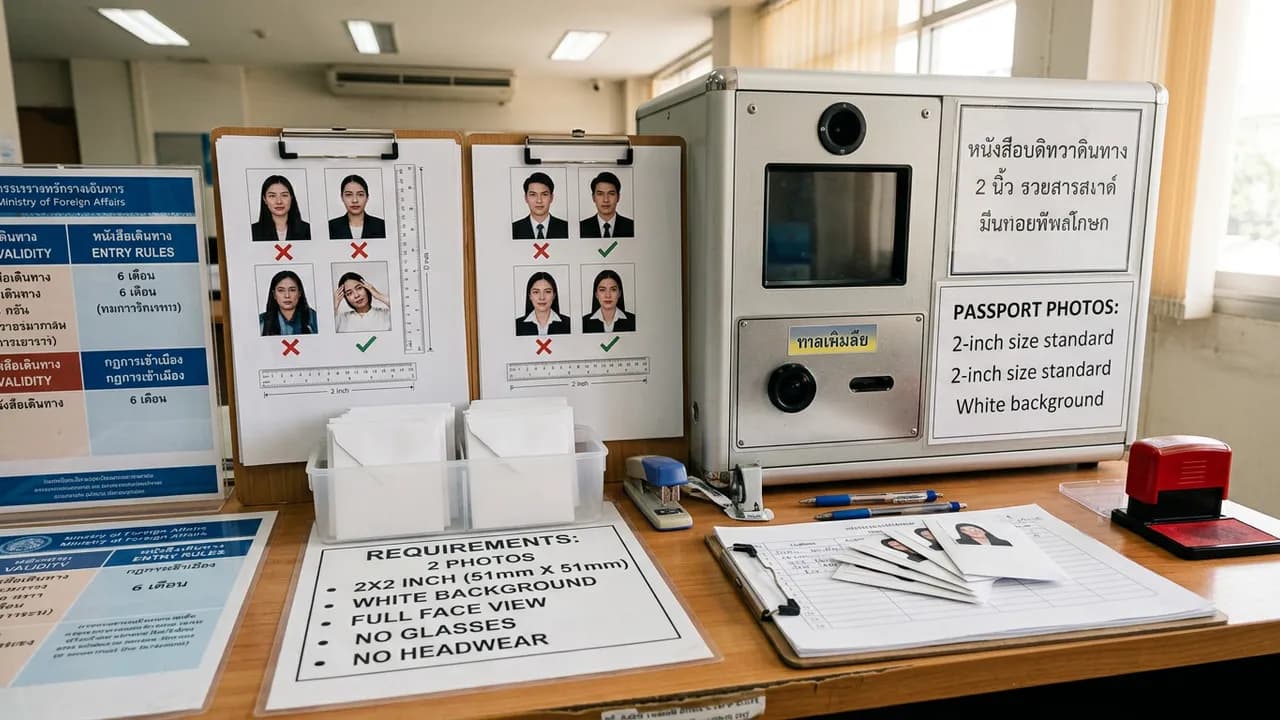
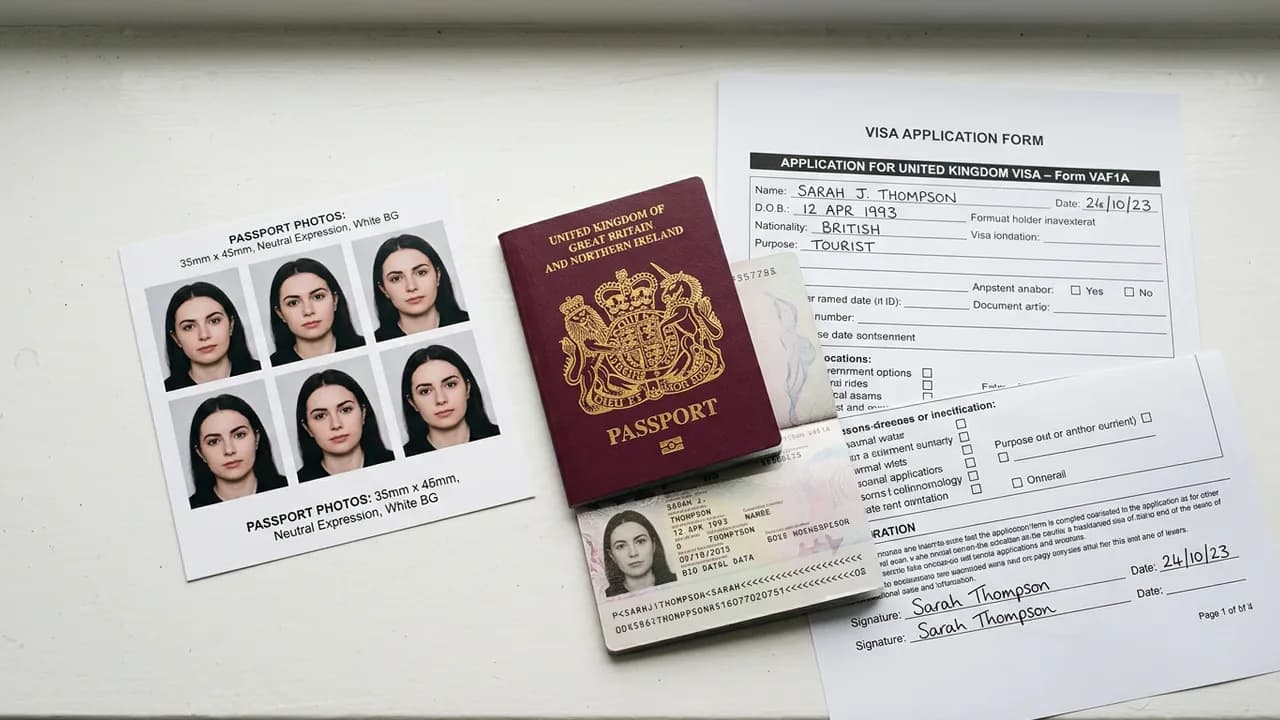
The standard Thai visa photo is 4 cm wide by 6 cm tall. This is taller than the typical 35mm x 45mm passport photo used for many European and US travel documents. If you bring standard passport photos that are the wrong size, the embassy may reject them.
| Measurement | Value |
|---|---|
| Photo width | 4 cm (40 mm) |
| Photo height | 6 cm (60 mm) |
| Head height (chin to crown) | 3.2 to 3.6 cm |
| Distance from top of photo to head | 0.4 to 0.8 cm |
| Face width | Approximately 2.5 to 3.5 cm |
Head Position and Framing
- Face the camera directly — no angled or profile shots
- Head should be centered horizontally in the frame
- Both ears should be visible
- Hair should not cover the face or eyes
- The top of the head (including hair) should have a small margin from the top edge of the photo
Digital Photo Requirements for e-Visa
When applying through the Thai e-Visa portal, you upload a digital version of your photo. The digital requirements are stricter than simply scanning a printed photo.
Digital Specifications
| Specification | Requirement |
|---|---|
| File format | JPEG (.jpg or .jpeg) |
| File size | Maximum 2 MB |
| Minimum resolution | 600 x 900 pixels |
| Recommended resolution | 800 x 1200 pixels |
| Color space | sRGB |
| Background | White, evenly lit, no shadows |
| DPI (if printing from digital) | 300 DPI minimum |
Tips for Digital Photos
- Do not simply scan a printed photo — the result is often blurry, poorly cropped, or has visible paper texture. Use a proper digital photo instead.
- Avoid selfies. Even high-quality smartphone cameras introduce distortion at close range, and the lighting is rarely compliant.
- Use natural or studio lighting. Avoid harsh overhead light that creates shadows under the nose and chin.
- The background must be pure white. Off-white, gray, or cream backgrounds will be flagged by automated systems.
- No digital filters or editing beyond basic brightness and contrast adjustments. Do not alter skin tone, remove blemishes, or reshape facial features.
Detailed Appearance Requirements
Face and Expression
- Neutral expression — no smiling, frowning, or raised eyebrows
- Mouth closed — teeth should not be visible
- Eyes open and clearly visible — no squinting, no closed eyes
- Look directly at the camera — eyes forward, not looking to the side
- Natural skin appearance — no heavy makeup that significantly alters your appearance
Glasses
As of current Thai visa requirements, glasses must be removed for the photo. This applies to:
- Prescription eyeglasses
- Sunglasses (obviously not permitted)
- Tinted lenses
- Reading glasses
If you have a medical condition that prevents you from removing glasses, contact the embassy in advance for guidance.
Head Coverings
Head coverings are not permitted in Thai visa photos unless worn for documented religious reasons.
| Situation | Permitted? |
|---|---|
| Religious head covering (hijab, turban, kippah) | Yes, if face is fully visible |
| Fashion accessories (hats, caps, headbands) | No |
| Medical head coverings | Contact embassy in advance |
If wearing a religious head covering, your full face from the bottom of the chin to the top of the forehead must be clearly visible. The covering must not cast shadows on the face.
Hair and Grooming
- Hair should be neatly groomed
- Long hair should not cover any part of the face
- Hair tied back is acceptable as long as both ears remain visible
- Wigs and hairpieces are permitted if they represent your normal daily appearance
Where to Get Compliant Photos
Professional Photo Studios
The most reliable option. Visit a photo studio that is experienced with visa and passport photos. Key points:
- Specify "Thai visa photo, 4x6 cm" when ordering — do not simply ask for passport photos
- Many studios in areas with Thai embassies are familiar with the requirements
- Expect to pay $10 to $25 depending on your location
- Studios typically provide both printed photos and a digital file
- Ask for the digital file even if you are submitting a paper application — it is useful for the e-Visa portal
Pharmacy and Retail Photo Booths
Chain pharmacies (CVS, Walgreens, Boots, etc.) and automated photo booths often offer passport photo services.
Caution: Many retail photo services default to the US passport size (2x2 inches / 51x51 mm) or the ICAO standard (35x45 mm). Neither matches the Thai 4x6 cm requirement. You must:
- Ask specifically for 4 cm x 6 cm photos
- Verify the staff understands this is different from a standard passport photo
- Check the result before leaving the store
At-Home Photos
If you cannot access a professional studio, you can take an acceptable photo at home with careful preparation.
Equipment needed:
- A camera or smartphone with at least 8 megapixels
- A plain white wall or a white sheet/backdrop
- Good lighting (two lamps on either side of the face, or face a window with natural light)
- A tripod or stable surface for the camera
Process:
- Stand approximately 1.5 meters from the white background
- Position the camera at face level, about 1.5 to 2 meters away
- Ensure even lighting with no shadows on the face or background
- Take several photos and select the best one
- Crop to 4:6 aspect ratio, ensuring proper head positioning
- Do not apply filters
Online Photo Services
Several websites and apps allow you to upload a photo and have it formatted to specific visa requirements. These can be useful but use them with caution:
- Results vary in quality
- Automated cropping may not meet precise Thai requirements
- Always review the output carefully before using it
- Some services offer printing and delivery for a small fee
Common Rejection Reasons
Understanding why photos get rejected helps you avoid mistakes. These are the most frequently cited reasons Thai embassies reject visa photos.
Top Rejection Reasons
| Reason | How to Avoid |
|---|---|
| Wrong dimensions | Specify 4x6 cm, not standard passport size |
| Non-white background | Use pure white only, no off-white or gray |
| Shadows on face or background | Use even front lighting, stand away from the wall |
| Wearing glasses | Remove all eyewear before the photo |
| Photo too old | Use a photo taken within the last 6 months |
| Expression not neutral | Keep mouth closed, no smile, neutral face |
| Low resolution (digital) | Use at least 600x900 pixels |
| File too large | Compress JPEG to under 2 MB for e-Visa |
| Face too small in frame | Ensure face occupies 70-80% of the frame |
| Head covering (non-religious) | Remove hats, caps, and headbands |
| Blurry or out of focus | Use a tripod or steady surface, proper focus |
| Red-eye | Use natural light or red-eye correction |
Less Obvious Rejection Reasons
- Visible photo borders or edges when scanning printed photos for digital upload
- Paper texture visible in scanned images
- Mismatched appearance — if you look significantly different from your passport photo (e.g., dramatic weight change, different hair color), it may cause questions but not outright rejection
- Ink stains or fingerprints on printed photos
- Glare on glossy prints if photos were scanned
Special Situations
Photos for Children
Children's visa photos follow the same 4x6 cm specification. Additional considerations:
- Infants must have eyes open and facing forward
- No pacifiers, toys, or other objects in the photo
- Parents or hands should not be visible in the frame
- The child should be the only person in the photo
- For very young children, lay them on a white surface and photograph from above
Recent Appearance Changes
If your appearance has changed significantly since your passport was issued (different hairstyle, weight change, aging), the visa photo should reflect your current appearance. The embassy compares the visa photo to your passport, but the visa photo should show how you look now.
Photos Taken Abroad
If you are applying for a Thai visa while traveling in a country other than your own, local photo studios may not be familiar with Thai specifications. Bring the exact measurements (4 cm x 6 cm) in writing, and if possible, show the studio an example image from the Thai embassy website.
Checklist Before Submitting Your Photo
Use this checklist to verify compliance before submitting:
- Photo is 4 cm x 6 cm (printed) or correct aspect ratio (digital)
- White background with no shadows
- Taken within the last 6 months
- Neutral expression, mouth closed
- Eyes open and clearly visible
- No glasses
- No head covering (unless religious)
- Face occupies 70-80% of the frame
- Both ears visible
- Full color, not black and white
- For e-Visa: JPEG format, under 2 MB, minimum 600x900 pixels
- For paper: Printed on quality photo paper, no smudges or creases
- Photo matches your current appearance
Final Thoughts
Getting your visa photo right is one of the simplest parts of the Thai visa process, yet it trips up a surprising number of applicants. The key differences from standard passport photos — particularly the 4x6 cm size and the strict white background requirement — catch many people off guard. Invest a few extra minutes and a few dollars in a properly taken, correctly sized photo, and you eliminate one of the most common causes of application delays.
When in doubt, visit a professional photo studio, specify the Thai visa requirements explicitly, and request both printed and digital copies. It is far easier to get the photo right the first time than to redo your entire application.